Why Sending Aadhaar on WhatsApp is Illegal Under the DPDP Act
Every Indian does it. Almost none of them know it is now a punishable offence.

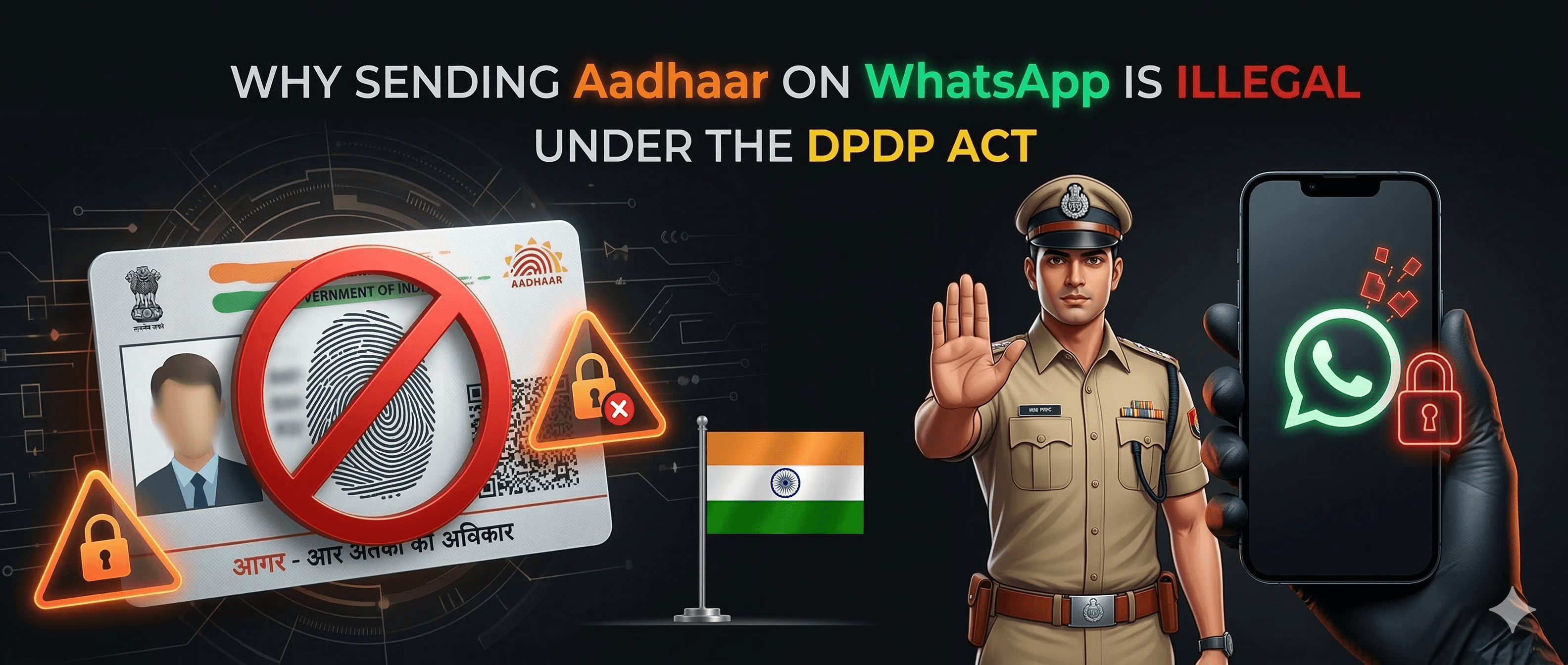
Open your WhatsApp right now.
Scroll back six months. There is a ninety percent chance you will find an Aadhaar card. Maybe yours. Maybe a family member's. Maybe someone you sent it to for a hotel check-in, a job application, a school admission, or a rental agreement.
Now imagine that conversation being used as evidence in a compliance investigation.
Under India's Digital Personal Data Protection Act 2023, the casual habit of sending Aadhaar copies over WhatsApp is no longer just a bad security practice. It is a violation of a law that carries penalties of up to rupees two hundred and fifty crore for organisations that enable it.
This article explains exactly why, what the law says, and what individuals and organisations need to do differently.
What Actually Happens When You Send Aadhaar on WhatsApp
Most people think of WhatsApp as a private conversation. It feels private. It looks private. But from a data security and legal standpoint it is one of the least appropriate channels for transmitting sensitive identity documents.
When you send an Aadhaar copy on WhatsApp:
- That image or PDF is stored on WhatsApp's servers, which are not in India
- It is stored on the recipient's phone, over which you have zero control
- It is stored in the recipient's cloud backup, whether that is Google Drive or iCloud, neither of which are Indian servers
- It is accessible to anyone who picks up that phone, borrows it, steals it, or gets access to the account
- It has no audit trail, no expiry, no access controls, no way to revoke it once sent
That Aadhaar copy you sent to a hotel in 2022 for a check-in still exists somewhere. Probably in three or four places simultaneously.
What the DPDP Act Says
The Digital Personal Data Protection Act 2023 came into force in August 2023. Full enforcement begins May 2027. It governs how personal data of Indian citizens is collected, stored, processed, and transmitted.
Aadhaar data is personal data under the Act. It is in fact among the most sensitive categories because it is a unique biometric-linked identifier that connects to your bank accounts, mobile number, tax records, and government benefits.
The Act creates clear obligations for any organisation that collects or handles personal data.
Consent must be obtained before collection. You cannot ask someone to send their Aadhaar unless you have clearly told them why you need it, what you will do with it, how long you will keep it, and who you will share it with. A verbal request or a WhatsApp message saying "please send your Aadhaar" does not constitute valid consent under the Act.
Reasonable security safeguards must be implemented. Transmitting sensitive personal data over an unencrypted consumer messaging application does not qualify as a reasonable security safeguard. WhatsApp messages, despite end-to-end encryption in transit, are stored in unencrypted backups and on recipient devices with no organisational access controls.
Data must be stored only as long as necessary. Once the purpose for collecting the Aadhaar copy is fulfilled, it must be deleted. An Aadhaar copy sitting in a hotel staff member's WhatsApp chat from a guest who checked out two years ago is a direct violation of this provision.
Data must be stored on systems with appropriate security. The Act requires that personal data be stored in systems with access controls, audit trails, and encryption. A WhatsApp chat has none of these.
Who is Liable
This is where most organisations get the wrong answer.
The individual who sent their own Aadhaar is not the primary concern. They are the data principal — the person whose data it is — and they have the right to share it as they choose.
The organisation that asked for it, received it, and stored it is the data fiduciary. They are responsible for everything that happens to that data from the moment it enters their systems. Or in this case, the moment it lands in their WhatsApp.
Hotels asking guests to send Aadhaar on WhatsApp. Hospitals asking patients to send identity documents over chat. Schools asking parents to send documents via messaging apps. Landlords asking tenants. Employers asking job applicants. Every single one of these scenarios creates liability for the receiving organisation under the DPDP Act.
The fact that WhatsApp is a common and convenient channel is not a legal defence. The law does not care about convenience. It cares about whether you implemented reasonable security safeguards for the personal data you chose to collect.
The Real Risk Beyond Legal Penalties
The legal penalties are significant. But the practical risks of Aadhaar data handled over WhatsApp are arguably more immediate.
Aadhaar numbers combined with names and dates of birth are enough to attempt identity fraud, SIM swap attacks, and unauthorised access to linked financial accounts. The Unique Identification Authority of India has documented numerous cases of Aadhaar-based fraud enabled by mishandled identity documents.
A hotel with five hundred Aadhaar copies in staff WhatsApp chats is not just a compliance risk. It is a breach waiting to happen. One lost phone, one compromised WhatsApp account, one disgruntled employee and five hundred guest identities are exposed.
For hospitals the stakes are even higher. Patient Aadhaar copies combined with medical history, diagnoses, and treatment records create a profile that can be used for insurance fraud, employment discrimination, and targeted scams. A medical data breach is not just a compliance event. It is a betrayal of patient trust that can end careers and close institutions.
What Organisations Need to Do Instead
The fix is not complicated. It is just different from what most organisations currently do.
Stop collecting Aadhaar on WhatsApp immediately. There is no compliant way to make WhatsApp a channel for Aadhaar collection. The channel itself is the problem. Stop using it for this purpose.
Use secure document collection links. The compliant way to collect Aadhaar and other identity documents is through a secure, encrypted, purpose-limited link. The individual clicks the link, uploads their document directly into an encrypted vault, the organisation gets access to what they need, and the entire transaction has a consent record, an audit trail, and a deletion timeline attached to it.
Implement a document management system with proper encryption. All collected identity documents should be stored in a system with AES-256 encryption at rest, access controls that restrict who can view documents, an immutable audit log of every access, and the ability to delete documents when their retention period expires.
Train your staff. The most secure system in the world fails if a receptionist asks the next guest to just send their Aadhaar on WhatsApp because it is easier. Everyone who handles personal data in your organisation needs to understand why the old way is no longer acceptable.
Build a consent record for every document you collect. Every time your organisation collects an Aadhaar copy or any other personal document, there should be a digital record of what was collected, why, with whose consent, by whom, and when it will be deleted.
What About Documents Already in WhatsApp
This is the question most compliance heads do not want to ask because the answer is uncomfortable.
Under the DPDP Act's data minimisation and storage limitation provisions, personal data should only be kept as long as necessary for the stated purpose. If you have a hotel full of guest Aadhaar copies in staff WhatsApp chats from the last three years, those need to be deleted.
Practically speaking, enforcement will begin with new violations rather than historical ones. But the moment enforcement begins, any organisation still operating WhatsApp-based document collection will be immediately non-compliant from that day forward.
The time to fix this is before May 2027. Not because the regulator will come knocking on day one. But because building a proper system takes time and the organisations that wait until the deadline are the ones that will make expensive, panicked mistakes.
The Bigger Picture
WhatsApp Aadhaar collection is a symptom of a much larger problem. India's organisations, across every sector, have built their document workflows around convenience rather than security. It worked for twenty years because there was no law requiring anything different.
That era is over.
The DPDP Act is India's signal that the country is serious about data rights. That Indian citizens deserve the same level of protection for their personal data that Europeans have had under GDPR since 2018. That the default response to "how do I collect your identity document" can no longer be "just WhatsApp it to me."
The organisations that understand this now and build proper infrastructure will find that DPDP compliance is not just a legal requirement. It is a competitive advantage. Enterprise clients, government contracts, and international partnerships increasingly require demonstrated data security practices. Being able to say that your organisation has never and will never handle personal data over WhatsApp is a statement of trust that money cannot buy quickly.
The One Line to Remember
Every Aadhaar copy sitting in a WhatsApp chat is a liability. A legal one, a security one, and a reputational one.
The question is not whether your organisation should stop this practice. The question is how quickly you can build the system that makes it impossible to do it the wrong way.
Sakshya is an AI-powered document intelligence platform built for Indian organisations. We provide secure, DPDP-compliant document collection links, zero-knowledge encrypted storage, and immutable audit trails so that hospitals, hotels, schools, NGOs, and businesses never have to ask for an Aadhaar over WhatsApp again.
Write to us at help@sakshya.io
Tags: #AadhaarSecurity #WhatsAppDataBreach #DPDPCompliance #DataPrivacyIndia #DataProtection2027 #CybersecurityIndia #DocumentManagement #StartupIndia
You may also like
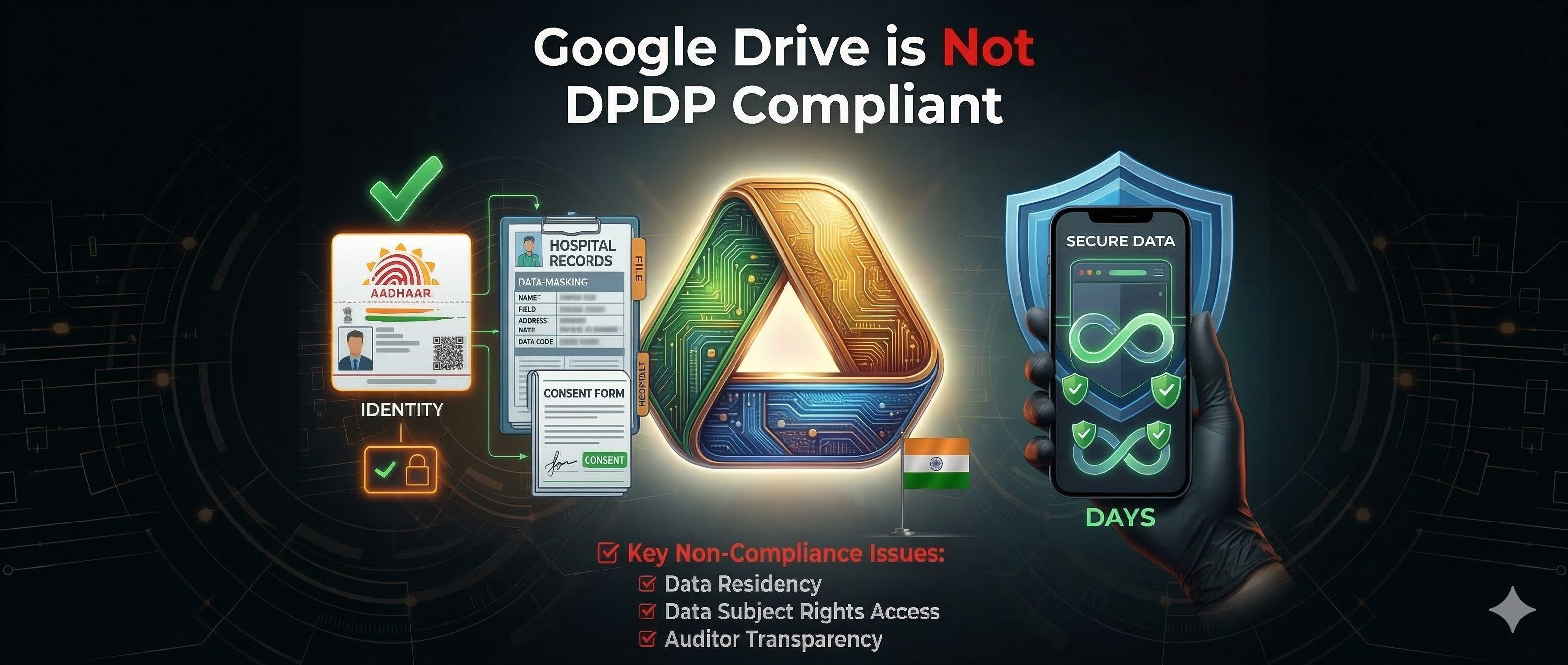
Google Drive is Not DPDP Compliant
If you work at an Indian organisation of any size, there is a very high chance your team is using Google Drive to store sensitive documents. Patient records. Employee Aadhaar copies. Vendor contracts. It feels safe. It is not.
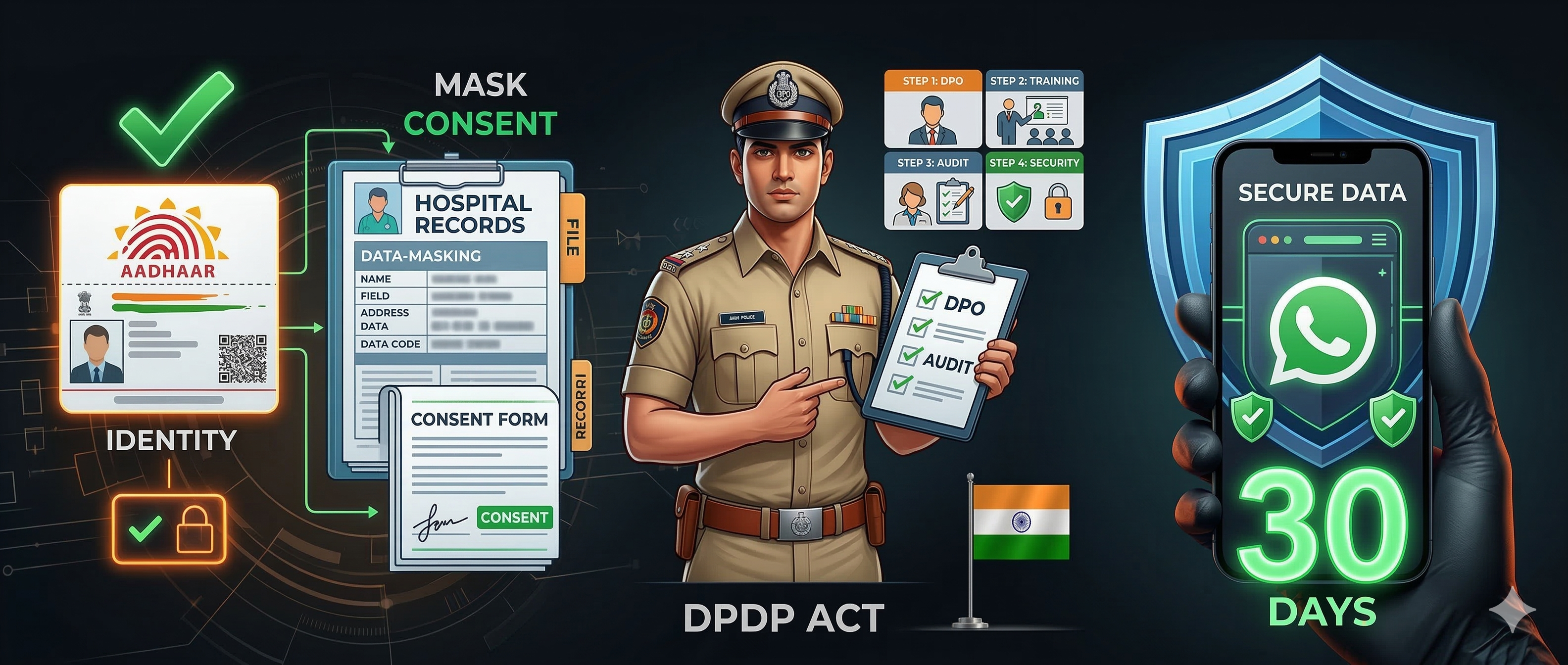
How Hospitals Can Become DPDP Compliant in 30 Days
India's hospitals are sitting on some of the most sensitive personal data in the country. Patient names, Aadhaar numbers, medical histories, diagnoses, treatment records, insurance details, and billing information. All of it collected daily, across hundreds of interactions.
Secure your data infrastructure.
Stay ahead of DPDP compliance with Sakshya's AI-first document gateway.